International College of Science
Last and First MenThe International College of Science governs who may practise science in the civilization of the First human species, turning specialist membership into both professional privilege and public authority. Its examination, fees, experimental license, and guarded technical secrets define science not simply as a body of knowledge but as an organized institution. In time, the College’s prestige is enlisted in a formal union of science and religion, even as the narrow specialization it embodies makes shared understanding harder to sustain.
Membership and professional authority
Scientific workers have organized themselves into a close corporation, and entry to the International College of Science requires passing an examination and paying high fees. Membership confers the title of Scientist and the right to conduct experiments; it is also an essential qualification for many lucrative positions. The College therefore controls more than a name. It regulates access to practical research and to careers that depend on scientific standing, giving its members a distinct institutional position in society.
The College’s authority grows in a culture that increasingly identifies science with material power. Among the First human species, science is honoured less for its past intellectual rigour or its account of the physical world than for its transformation of material life. Invention continues to improve industrial technique, while pure intellectual curiosity has waned and scientific doctrines have hardened into elaborate dogma. The Scientist is consequently treated as an embodiment of power as well as knowledge. The College’s exclusive membership system gives this wider reverence an organizational form.
Secrecy and divided knowledge
The College’s members are said to be bound by technical secrets they must not reveal. Rumour holds that at least one member who disclosed a minor secret died mysteriously soon afterward. The account presents this as a report circulating around the institution, not as an openly documented College rule or confirmed act. Even as rumour, however, it sharpens the sense that scientific knowledge is guarded and that membership carries obligations beyond passing examinations and conducting research.
The growing complexity of science makes that guarded knowledge harder to oversee. No single mind can master more than a tiny fraction of the total corpus, and researchers in one branch may know practically nothing about related work in another. Subatomic Physics is especially divided: it contains a dozen studies, each as complex as all the physics of the nineteenth-century Christian era. Specialists are reluctant to criticize or even understand other fields, while departments carefully respect one another’s territory. The technical discipline of philosophy, which had once helped coordinate and criticize the sciences, no longer exists. Popular understanding instead rests on a loose pseudo-scientific framework assembled by journalists from striking phrases, which scientific workers themselves profess to reject even while unknowingly relying on it.
This compartmentalization has a particular effect when rumours arise about Gordelpus, the god of motion. Each department hesitates to deny that its own researchers possess the secret, yet is willing to believe that another department may have it. The conduct of scientists as a body therefore strengthens public suspicion that they know the secret and refuse to disclose it. The College’s specialist structure, valuable for advanced research, helps preserve uncertainty about what science actually knows.
Incorporation into religious authority
About two centuries after the formation of the First World State, the President of the World calls a conference to unite science and religion. Leaders of Buddhism, Mohammedanism, Hinduism, the Regenerate Christian Brotherhood, and the Modern Catholic Church in South America agree to treat their differences as differences of expression. They recognize the Divine Energy in activity or tense stillness and accept the saintly Discoverer as a prophet or an incarnation of divine Movement. Their agreement supplies the religious side of a settlement that will give scientific authority a formal sacred office.
The conference proceeds from the widespread belief that scientists possess the supreme secret, though they will not admit it. The President calls for the organizations of science and religion to merge and asks the International College of Science to nominate a select group from its members. The Church sanctifies these nominees as the Sacred Order of Scientists. Public funds support them so they can devote themselves to science and, in particular, to researching the most scientific manner of worshipping Gordelpus, the god of motion. The College thus becomes the source of personnel for an institution that joins research, religious service, and public authority; the Sacred Order, rather than the College itself, is destined to dominate human affairs until the downfall of the first world civilization.
The response among those present is mixed. A few scientists appear uncomfortable, while most conceal their satisfaction beneath a show of deliberation. The priests, too, display differing reactions, though the prevailing view is that the Church will gain by taking science’s prestige into itself. The College’s nomination gives the new Order a claim to scientific legitimacy, while religious sanctification recasts scientific work as service to divine power.
Demonstration, crisis, and legacy
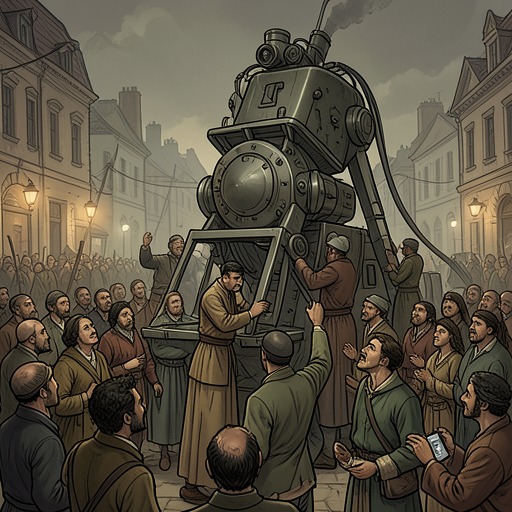
At a later meeting convened to demonstrate the use of subatomic energy, a young Mongol presents an instrument capable of initiating the annihilation of matter at a distance and in a precise direction, as well as inhibiting the process. He argues that the device could end war and that a further instrument might provide unlimited industrial power. The attending scientific society votes unanimously to order the instrument and every account of it destroyed. The young scientist agrees, though he laments the destruction of ten years of work and says he expected gratitude rather than exclusion. The scene shows scientific authority confronting a technology whose destructive capacity outstrips confidence in its responsible use; it does not establish that the College itself held this vote.
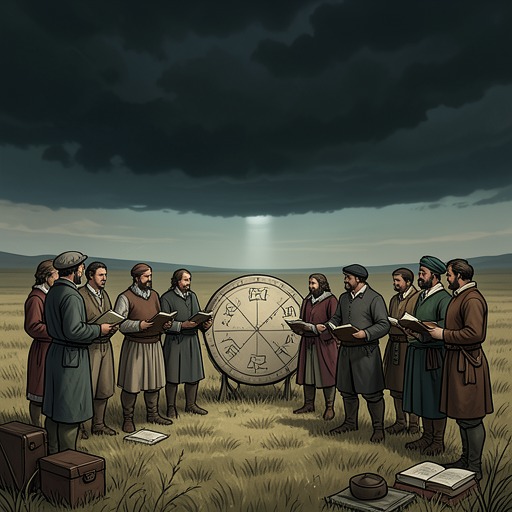
Later, as the civilization’s resources deteriorate and doubt spreads, scientists secretly search ancient scientific literature for a forgotten means of recovery and conduct clandestine experiments along a false trail. Several researchers are poisoned or electrocuted, and a great college is blown up. The public interprets the destruction as an exercise of divine potency; the scientists then stage further apparent miracles, using them to quiet unrest among hungry workers. The account does not explicitly identify the destroyed college by name. These episodes nevertheless bring the institutional world represented by the International College into sharp relief: scientific expertise remains prestigious and politically consequential, but secrecy, fragmented knowledge, and religious interpretation have left the public unable to distinguish research, error, and manufactured proof.